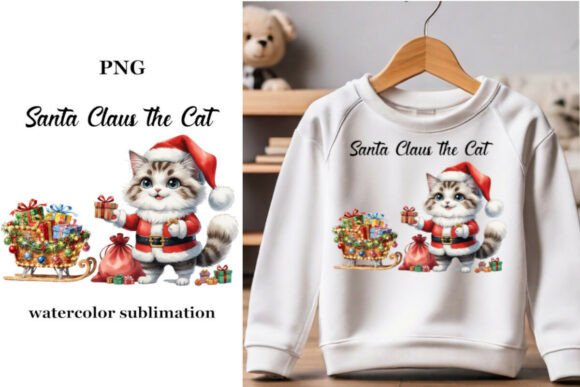
Mastering Holiday Designs with Santa Claus Cat Watercolor Sublimation
The holiday season brings a unique rush for creators, small business owners, and hobbyists alike. There is a specific charm in blending traditional festive imagery with modern trends, and nothing captures this quite like the Santa Claus Cat Watercolor Sublimation design. This illustration style merges the whimsical nature of feline characters with the soft, artistic texture of watercolors, creating a product that feels both cozy and contemporary. However, diving into digital downloads for commercial or personal projects requires more than just a quick purchase. To ensure your final products—from t-shirts to mugs—look professional, you need to understand the technical nuances of working with high-resolution PNG files versus other formats.
Many enthusiasts jump straight into downloading assets without verifying the file specifications, leading to frustration when the image does not behave as expected in their design software. A common misconception is assuming that any digital image can be used for any crafting method. For instance, the Santa Claus Cat watercolor sublimation PNG provided in high-quality packs is specifically engineered for printing processes that require transparency and high pixel density. It is not a vector file. Understanding this distinction is the first step toward avoiding wasted materials and time.
Understanding File Formats: The PNG vs. SVG Trap
One of the most frequent errors creators make is confusing raster images with vector graphics. When you purchase a Santa Claus Cat illustration intended for sublimation, you are typically receiving a PNG file. This format is excellent for preserving complex details like watercolor bleeds, soft edges, and transparent backgrounds. However, a critical limitation exists: this is not an SVG file.
Why does this matter? If you intend to use a cutting machine (like a Cricut or Silhouette) to create vinyl decals, an SVG file is usually required because it contains mathematical paths that the machine follows. A PNG is a grid of pixels. While some software can "trace" a PNG to create a cut path, the result is often jagged or loses the delicate watercolor effect that makes the design appealing. Attempting to convert a high-detail watercolor PNG directly into a clean cut file often results in a loss of quality or an overly complicated path that is difficult to weed.
The Better Approach: Before buying, define your end goal. If you are sublimating onto polyester fabrics, ceramic mugs, or tumblers, the PNG format is perfect. The transparent background allows the design to sit seamlessly on colored substrates without a white box around it. If you need a vinyl sticker, look for bundles that explicitly include an SVG version or be prepared to manually trace the image in your vector software, accepting that some fine watercolor details may need simplification.
Resolution and Scaling: Avoiding the Pixelation Pitfall
Another area where beginners often stumble is resolution management. A standard web image might be 72 DPI (dots per inch), which looks fine on a screen but appears blurry and blocky when printed. High-quality sublimation demands clarity. The ideal asset, such as the Santa Claus Cat Watercolor Sublimation files described in premium shops, should offer dimensions around 3000 x 3600 pixels at 300 DPI.
When you download a file, always check these metrics immediately. If you attempt to stretch a smaller image to fit a large pillowcase or a full-front t-shirt print, the pixels will expand, resulting in a fuzzy, unprofessional finish. This is particularly damaging for watercolor styles, where the beauty lies in the crispness of the brush strokes and the gradient transitions.
Practical Advice: Always design at 100% scale in your editing program. If your file is 10 x 12 inches at 300 DPI, do not try to print it at 20 x 24 inches. Instead, utilize the high resolution to create sharp prints within the recommended size limits. For larger projects, consider tiling the design or purchasing an extended license for a larger format if available. Remember, you cannot add resolution to an image after the fact; you can only lose it.
Color Accuracy and Monitor Calibration
Digital design carries an inherent variable: screen disparity. The vibrant reds of Santa's hat and the soft grays of the cat's fur on your monitor may not perfectly match the output on your sublimation printer. This is not necessarily a flaw in the Santa Claus Cat illustration itself, but rather a reality of color management.
Many users blame the file creator when colors shift, overlooking their own monitor settings or printer profiles. Standard monitors often display colors in RGB (Red, Green, Blue), while printers operate in CMYK (Cyan, Magenta, Yellow, Key/Black) or use specific sublimation ink profiles. Without calibration, a deep crimson might print as a dull brick red, or a soft blue might turn purple.
How to Mitigate Color Shifts:
- Perform test prints on scrap sublimation paper before committing to expensive blanks like coated mugs or premium shirts.
- Adjust your printer settings to match the specific sublimation paper and ink brand you are using.
- Understand that slight variations are normal. The goal is consistency across your batch, not necessarily an exact match to your uncalibrated screen.
Maximizing Versatility Across Projects
The true value of a high-quality watercolor sublimation PNG lies in its versatility. Once you have the correct file in a Zip folder, the applications are nearly endless. However, applying the same design logic to every surface is a mistake. Different materials absorb ink differently.
For example, when creating greeting cards or scrapbook pages, the porous nature of paper absorbs ink readily, often making colors appear slightly darker than on non-porous surfaces. Conversely, when sublimating onto mugs, pillows, or business cards with a polymer coating, the ink sits on the surface, retaining high vibrancy.
Creative entrepreneurs can leverage this single asset for a wide range of inventory:
- Apparel: T-shirts and tote bags made of high-polyester blends for bright transfers.
- Home Decor: Throw pillows and framed art prints that capitalize on the artistic watercolor aesthetic.
- Party Supplies: Custom invitations and favor tags for children's holiday parties.
- Digital Content: Blog headers, social media quotes, and website banners where the transparent background saves editing time.
Just remember that while the file is versatile, the substrate must be compatible with sublimation. You cannot sublimate directly onto 100% cotton or dark-colored items without special transfer papers or layers, which alters the final look of the watercolor effect.
Final Checklist Before You Create
To ensure satisfaction and efficiency in your workflow, run through this quick mental checklist before starting your project with the Santa Claus Cat Watercolor Sublimation files:
- Verify the Format: Confirm you have a PNG with a transparent background. Do not attempt to use it as a cut file unless you are skilled in tracing.
- Check Resolution: Ensure the file is 300 DPI and large enough for your intended print size (e.g., 3000 x 3600 pixels).
- Prepare Your Workspace: Have a computer ready to unzip the folder and a design program (like Photoshop, Canva, or Illustrator) that supports PNG layers.
- Test Colors: Run a small test print to gauge how your specific printer handles the watercolor gradients.
- Review Licensing: If you are selling finished goods, ensure your purchase includes a commercial license for physical products.
By paying attention to these details, you transform a simple digital download into a professional-grade asset. The Santa Claus Cat theme offers a delightful twist on holiday traditions, appealing to cat lovers and design enthusiasts alike. With the right preparation and an understanding of the technical requirements, you can produce stunning cards, apparel, and decor that stand out in the crowded holiday market. Happy creating, and thank you for visiting our shop to find the perfect graphics for your next masterpiece.